What is OTE (on-target-earnings)? OTE Meaning and Usage

TL;DR: OTE (on-target earnings) is the total compensation a sales rep earns when they hit 100% of their quota: base salary plus variable pay. A $120K OTE with a 60/40 split means $72K base and $48K in commission. Setting OTE correctly requires choosing the right pay mix by role, building a realistic quota multiplier, and having a system that tracks and pays it accurately every single month.
Every sales job posting has an OTE number. Every rep negotiates against it. Every Finance team has to reconcile it at the month-end.
The concept is simple. The execution is where it falls apart.
Most companies can articulate what OTE means. Far fewer have a compensation system that reliably delivers it. When commission tracking lives in spreadsheets, the gap between the OTE a rep was promised and what they actually receive at payout becomes both a finance accuracy problem and a rep trust problem at the same time.
This guide covers three things: what OTE means and how it is calculated, how to design pay mixes and quotas that make OTE realistic by role, and what actually causes OTE to break down in practice, and how to fix it.
What Does OTE Mean in Sales?
OTE stands for on-target earnings. It is the total compensation a salesperson can expect to earn if they hit exactly 100% of their quota. It combines base salary and variable pay, which includes commissions, bonuses, or both, into a single number.
OTE = Base Salary + Variable Pay at 100% Quota
OTE is not a guaranteed salary. It is not a ceiling. It is a target. Reps who exceed their quota typically earn above OTE through accelerators (more on that below). Reps who miss quota earn below it.
A few important clarifications:
- OTE is used in job postings, offer letters, and comp plan design to communicate total earning potential.
- The "on-target" qualifier matters: the full number only materializes when 100% quota attainment is reached.
The number you see in a job listing, "$120K OTE" or "$200K OTE," includes base salary. It is not additional income on top of the base.
How Is OTE Calculated?
The formula is straightforward. The complexity comes when you model what happens at different attainment levels, which is exactly where most comp plan conversations stop too early.
OTE = Base Salary + Target Variable Compensation (at 100% quota)
Example:
- Base salary: $70,000
- Commission rate: 8% on $625,000 annual quota
- Variable at 100% attainment: $50,000
- OTE: $120,000
Use this Visdum OTE Calculator to model this for your own numbers instantly.
.webp)
What most definitions skip is the attainment table. Here is what the same rep earns at different quota attainment levels, including a 1.5x accelerator above 100%:
| Quota Attainment | Variable Earned | Total Earnings |
|---|---|---|
| 75% | $37,500 | $107,500 |
| 100% (OTE) | $50,000 | $120,000 |
| 120% (with 1.5x accelerator) | $75,000 | $145,000 |
| 150% | $90,000+ | $160,000+ |
This table matters for two audiences. For reps evaluating a job offer, it shows the realistic earnings range, not just the headline number. For managers designing comp plans, it shows the cost of accelerators at the high end, which is where compensation forecasting errors most often occur.
What Is a Good OTE Pay Mix by Role?
Pay mix is the ratio of base salary to variable pay within OTE. A $120K OTE with a 60/40 split means $72K base and $48K variable. Getting this ratio wrong has real consequences: too much variable on a role with limited revenue leverage creates instability, and too little variable on a closing role removes the performance incentive entirely.
Pay mix should reflect the actual revenue leverage of each role, not a company-wide default.
| Role | Typical Pay Mix (Base/Variable) | Rationale |
|---|---|---|
| SDR / BDR | 70/30 or 75/25 | Activity-based, not revenue-closing |
| Account Executive | 50/50 or 60/40 | Direct revenue responsibility |
| Sales Engineer | 70/30 to 80/20 | Supporting, not owning the close |
| Account Manager (renewals) | 75/25 to 80/20 | Lower risk, more predictable book |
| Sales Manager | 60/40 to 70/30 | Team leverage, not direct quota |
| VP of Sales | 50/50 to 60/40 | Full P&L accountability |
The data point most RevOps leaders underestimate: SDRs on aggressive 50/50 splits churn faster and focus on quantity over quality of pipeline. A 70/30 structure keeps them stable while still creating meaningful performance incentives.
For a deeper breakdown of how to structure pay mix against quota targets, see the Quota-to-OTE Ratio guide.
What Are OTE Benchmarks by Role in 2026?
OTE benchmarks vary significantly by role, company stage, and market. The table below reflects May 2026 compensation data for US B2B sales roles, sourced from RepVue's verified salary database, which aggregates self-reported data across thousands of active sales professionals.
| Role | Median Base | Median OTE | Top Performer OTE | Typical Quota |
|---|---|---|---|---|
| SDR / BDR | $60,000 | $85,000 | $127,955+ | $400K-$600K |
| SMB Account Executive | $70,000 | $135,000 | $278,474+ | $500K-$800K |
| Mid-Market Account Executive | $90,000 | $180,000 | $405,190+ | $800K-$1.2M |
| Enterprise Account Executive | $140,000 | $270,000 | $654,927+ | $1.5M-$3M+ |
Two things this table does not show, but should inform every comp planning conversation:
First, only about 42% of AEs hit quota in any given year, per RepVue's attainment data. The Salesforce State of Sales report (2024) puts it even more bluntly: 67% of reps don't expect to meet their quota, and 84% missed it the prior year. If your OTE is designed assuming 100% attainment is the norm, your comp plan is already misaligned with the reality your reps are living.
Second, the spread between median OTE and top performer OTE widens sharply as you move up-market. An Enterprise AE top performer earns 2.4x the median. That spread is created almost entirely by accelerators, not by base salary differences. A well-designed accelerator structure is what separates a comp plan that retains top talent from one that caps earning potential at exactly 100% quota.
What Is the Quota-to-OTE Ratio and Why Does It Matter?
The quota-to-OTE ratio is total quota divided by OTE. A rep with a $200,000 OTE and a $1,000,000 quota has a 5x ratio. A rep with the same OTE and a $2,000,000 quota has a 10x ratio.
For SaaS AEs, the industry benchmark is a 5x to 8x quota-to-OTE ratio. Here is what happens at the extremes:
- Below 4x: The company is paying too much per dollar of revenue generated. OTE expectations are likely misaligned with the revenue model.
- Above 10x: Quotas are probably unrealistic. Reps stop believing the OTE number is achievable, which creates disengagement and attrition.
This ratio is not just a finance check. It is the single most important signal of whether your OTE structure will actually motivate the behaviors you need.
A RevOps lead at a 60-person SaaS company set AE OTE at $160,000 with a 50/50 split: $80,000 base and $80,000 variable on a $700,000 quota. That is an 11.4% commission rate at 100% attainment and a 4.4x quota-to-OTE ratio. That ratio is borderline for an SMB AE role. At 120% attainment with a 1.5x accelerator, the variable earned becomes $112,000, pushing total comp to $192,000. At 150% attainment, total comp reaches $228,000. None of that math is complicated. But it is the kind of scenario that reveals whether a comp plan is financially sustainable before the fiscal year starts, not after it ends.
Also Read: Visdum’s definitive guide to Quota-to-OTE ratio design.
How Do Accelerators and Clawbacks Affect OTE?
OTE is a target, not a ceiling. The two mechanisms that change actual earnings beyond OTE are accelerators and clawbacks.
Accelerators are higher commission rates that activate after a rep exceeds 100% quota attainment. Most SaaS comp plans include a 1.25x to 2x multiplier above the 100% threshold. This means a $120K OTE can realistically become $145K to $180K for top performers. Accelerators are the primary reason top performers earn two to three times more than average performers at the same OTE level.
Clawbacks work in the opposite direction. If a deal churns within a defined window (typically 90 to 180 days), some or all of the commission may be recovered. Clawbacks protect the company from paying commission on revenue that did not materialize. They are increasingly standard in SaaS companies with subscription models and quarterly payment cycles.
Both mechanisms add operational complexity to what sounds like a simple calculation:
- Accelerator tiers must be applied at the right thresholds in the right period, not retroactively after the quarter closes.
- Clawbacks require tracking deal events tied to specific commissions over a rolling window, which is impossible to do reliably in a spreadsheet.
A rep tracking their OTE progress in a spreadsheet has no reliable way to see accelerator impact in real time or to anticipate clawbacks that have not yet been triggered. The calculation is always one deal event behind.
What Should Be Included in an OTE Compensation Agreement?
A well-structured OTE agreement eliminates disputes before they start. For hiring managers, Finance leads, and HR teams building comp plans, here is what every agreement must define:
- Base salary amount and payment schedule (bi-weekly, monthly)
- Commission structure: rate, tier levels, and whether a cap applies
- Quota definition: ARR, new bookings, revenue, or a blended metric
- Quota period: annual, quarterly, or monthly measurement
- Accelerator tiers: specific rate multipliers and the attainment thresholds that trigger them
- Clawback terms: duration window and the specific events that trigger recovery
- Credit timing: when a deal becomes commissionable (signature, invoice, payment received)
- Split and overlay rules: how credit is divided when multiple roles touch the same deal
- Plan version and effective date: which plan version governs which period
The last item is the one most companies skip, and it is the one that creates the most disputes. When a comp plan changes mid-year, every rep should have a documented record of which plan version applied to which deals. Without that, Finance and RevOps regularly produce different payout numbers for the same period. For short-term performance boosts outside the standard OTE structure, SPIFFs serve a related but distinct purpose.
Why Does OTE Break Down at Scale?
OTE is a clean concept. It has a consistently messy execution layer. The failure is not in the formula. It is in the infrastructure that companies use to track it.
Most sales organizations are managing OTE fulfillment through a combination of CRM exports, spreadsheets, and manual reconciliation. That creates a predictable set of failure modes:
- Commission data is only as current as the last export, often weekly or monthly.
- Reps cannot see real-time attainment toward their OTE number.
- Plan changes mid-year require manual spreadsheet updates across every affected rep's calculation, creating high error risk.
- Accelerator tiers are applied retroactively or inconsistently, leading to reconciliation delays at quarter-end.
- Clawbacks are tracked informally or not at all until a dispute surfaces.
- Finance and RevOps work from different data sources and regularly produce mismatched payout numbers for the same period.
The operational consequence is not just inefficiency. It is rep trust erosion. When a sales rep cannot verify their OTE attainment in real time, and payouts arrive with unexplained variances, the compensation system itself becomes a retention risk.
Subex, a global telecom AI company, ran into a different version of the same problem. With 100+ commissioned sellers across five currencies and 15+ unique comp plans, frequent mid-year policy changes made it impossible to maintain accurate calculations without rebuilding spreadsheet logic from scratch every time. Reps had no visibility into deal-level payouts, which created consistent disputes and eroded trust in the compensation system. Visdum automated the full calculation layer across all currencies and plan versions, with mid-year changes accommodated without manual reconstruction. Every rep gained a personal dashboard with deal-level payout visibility.
Read the Subex case study
The real issue is not complexity. It is the absence of a reliable calculation layer between CRM data and payout. The next section covers exactly what that layer looks like.
How Does Visdum Help You Track and Pay OTE Accurately?
The problem described above has a direct solution: a compensation platform that replaces the spreadsheet calculation layer with automated logic tied to live deal data.
Visdum is built for exactly this scenario. Here is how it addresses each failure mode:
- Real-time calculation: Commission data pulls from CRM and ERP systems continuously, not through periodic exports. Attainment figures are current.
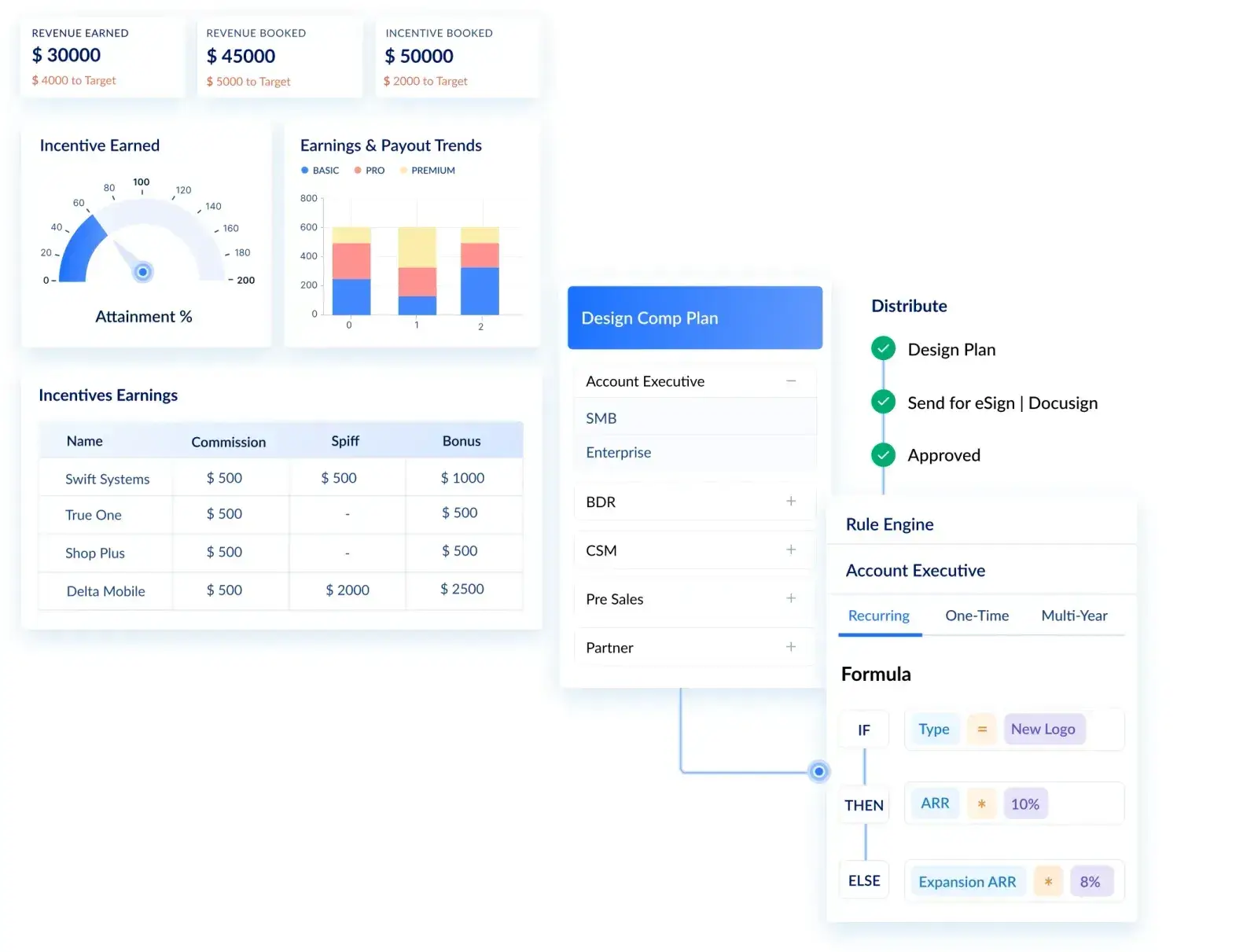
- Rep-facing dashboards: Every rep sees their current attainment toward OTE, variable earned to date, and projected payout, without sending a message to RevOps to ask. That commission visibility for sales reps extends to mobile, breaks earnings down deal by deal, and lets reps compare quarters, switch currencies and download their own payout summaries.
- Accelerator logic built into the plan: Accelerator tiers are configured once and applied automatically at the correct thresholds, in the correct period.
- Clawback tracking tied to deal events: When a deal churns within the clawback window, the adjustment is logged and applied automatically, with a full audit trail.
- Plan versioning: Mid-year plan changes are managed at the plan level, not the spreadsheet level. Historical calculations are preserved under the version that was active at the time of payment.
- Dispute resolution in minutes: Every calculation is logged with the plan version, the deal ID, and the attainment level at the moment of payout.
CV Library eliminated its 25+ separate spreadsheet workflows and reduced time spent on compensation administration by 90% after implementing Visdum. Subex automated commission calculations for 100+ reps across 20+ locations and 5 currencies, with mid-year plan changes now accommodated without manual data reconstruction.
Read the CV Library case study
.webp)
Conclusion
OTE is one of the most commonly cited numbers in sales, and one of the least reliably executed. Setting a competitive OTE by role, with the right pay mix and a realistic quota-to-OTE ratio, is a solvable design problem. Every RevOps leader knows how to do it.
What consistently breaks is the layer beneath the design: the calculation logic, real-time tracking, accelerator application, clawback management, and audit trail. When that layer lives in spreadsheets, errors accumulate quietly until they surface as a rep dispute or a Finance reconciliation gap.
The companies that get this right treat OTE delivery as infrastructure. The design comes first. The system that makes delivery reliable comes second, and it matters just as much. Here's what to look for in a commission management system before you build that layer.
Frequently Asked Questions About OTE in Sales
What is OTE in sales?
OTE, or on-target earnings, is the total compensation a sales rep can earn if they hit 100% of their sales quota. It is the sum of base salary plus variable pay (commission, bonus, or both) at full quota attainment. It represents a target, not a guaranteed amount.
How is OTE calculated?
OTE = Base Salary + Variable Pay at 100% Quota. If your base is $70,000 and your commission rate is 8% on a $625,000 quota, your variable at 100% is $50,000, making your OTE $120,000. Use the Visdum OTE Calculator for a full attainment breakdown.
What does $100K OTE mean in practice?
It means you can expect to earn $100,000 total (base plus commission) if you hit 100% of your quota. Depending on your pay mix, that might be $60K base and $40K variable. Whether $100K is achievable depends entirely on whether the quota is realistic: ask what percentage of reps actually hit it.
What is a good OTE pay mix for an account executive?
A 50/50 or 60/40 base-to-variable split is standard for AEs with direct revenue responsibility. A 70/30 split is more common for SDRs or roles without direct closing responsibility. The right mix depends on the role's revenue leverage and the company's risk preference.
What does it mean when OTE is uncapped?
Uncapped OTE means there is no ceiling on variable earnings. A rep who closes at 200% of quota earns 2x (or more, with accelerators) on their variable component. Uncapped structures are common in enterprise AE roles and are often used to attract high performers who expect to exceed quota consistently.
How are accelerators different from base commission?
Base commission is the standard rate applied to quota attainment up to 100%. Accelerators are higher commission rates that apply when attainment exceeds 100%, typically 1.25x to 2x the base rate. They create a non-linear earnings curve that rewards top performance disproportionately.
Can a company pay below OTE?
Yes. OTE is a target, not a guarantee. If a rep attains 80% of quota, they earn the commission corresponding to that attainment level, which is below their stated OTE. The key question for reps evaluating a role: what is the actual median attainment for this position at this company?
How does Visdum calculate and track OTE?
Visdum connects to your CRM and ERP to pull live deal data, calculates commissions against configured plan rules, applies accelerator logic automatically at the correct attainment thresholds, and provides rep-facing dashboards showing real-time earnings toward OTE. Every calculation is logged with a full audit trail, so disputes are resolved from data, not from memory. If you're evaluating the broader software landscape before committing, here's how leading sales commission platforms compare in 2026.