
AI-Powered Financial Audit Software: A Practical Guide to the Best Tools
.webp)
Let me start with something most finance teams don’t say out loud.
Audits don’t break because they’re complex. They break because the way we execute them hasn’t kept up with how businesses actually operate today.
Financial data is scattered across ERP systems, CRMs, payroll tools, and spreadsheets that rarely sync in real time. Teams spend days reconciling numbers before validation even begins. And just when clarity is most critical, timelines tighten.
According to the ACFE Report to the Nations (2024), organizations lose nearly 5% of annual revenue to fraud. Many of these issues stem from weak internal controls and a lack of continuous monitoring.
I’ve seen this firsthand. By the time discrepancies are discovered, they’re buried under layers of dependencies, making them harder and more expensive to fix.
Now add scale: more transactions, more systems, and more compliance pressure. What should be a structured process quickly becomes fragmented and reactive.
This is exactly the problem AI-powered financial audit software is designed to solve. Before we go deeper, let me quickly define what I mean.
What is a Financial Audit?
A financial audit is a structured review of a company’s financial records to ensure they are accurate, complete, and compliant.
It involves checking financial statements, verifying transactions with supporting documents, and testing controls to prevent errors or fraud.
The goal is to identify risks or discrepancies and provide a clear, reliable audit report.
What is AI-powered financial auditing?
AI-powered financial auditing means using artificial intelligence to automatically analyze financial data, detect errors or fraud, and help auditors review financial systems and statements faster and more accurately. AI-powered audit tools also enable real-time detection of such anomalies, making auditing a process that runs throughout, instead of after.
Why do financial audits break as companies scale?
Financial audits are hard, not because the concepts are complex, but because of how they operate in real organizations.
Data lives across ERP systems, CRM platforms, payroll tools, and spreadsheets that are rarely synchronized. Teams spend days reconciling numbers before validation even begins.
Here are the main audit blockers that companies face:
1. Poor data quality
Inconsistent, incomplete, or duplicate financial data leads to errors, rework, and delays during audit validation.
2. Lack of process standardization
Disconnected workflows and non-standard processes make it difficult to trace transactions and ensure compliance across teams.
3. Manual, spreadsheet-heavy systems
Heavy reliance on spreadsheets increases the risk of errors, version control issues, and limited audit trails.
4. Weak internal controls and documentation
Insufficient documentation and unclear controls create gaps in compliance and make audits harder to verify and defend.
Did you know? Resolve reports that automation and AI in financial systems can reduce processing times by up to 70%, highlighting the scale of inefficiencies in fragmented financial workflows.
This is where traditional financial audit software reaches its limits and where AI-powered systems fundamentally change what audits can do.
Why does traditional financial audit software fail at scale?
A financial audit exists to ensure the accuracy, compliance, and reliability of financial statements. That objective has not changed. The data environment has.
So where does audit risk actually begin?
In modern systems, risk begins during data preparation, not review.
Finance teams must reconcile disconnected data sources before validation. This process is:
- Time-consuming
- Error-prone
- Often incomplete
Why do traditional systems create blind spots?
Traditional audit tools rely on:
- Sampling
- Periodic reviews
- Rule-based checks
These approaches fail in high-volume environments. Sampling leaves gaps, and rules cannot adapt to dynamic financial behavior.
How do AI-powered audit systems differ from traditional ones?
AI in auditing has moved far beyond generic efficiency claims. Today’s tools actively support key stages of the audit lifecycle, helping teams cut down manual effort while improving consistency and audit quality.
AI assistants can help finance teams deliver insights on budget variances across business units, replacing manual number crunching and saving up to 30% of their time. — McKinsey & Company
How to Evaluate AI-Powered Financial Audit Tools
Since many tools sound similar at a surface level, choosing the right one requires a structured evaluation approach.
1. Reliability and source-backed outputs
The first question to ask is simple: Can you trust the output?
AI tools should deliver accurate outputs with clear traceability to underlying financial data, not just polished summaries. Otherwise, they increase review effort instead of reducing it.
2. Alignment with your existing workflows
The second important question then is: Can it work with my existing stack?
The best tool isn’t the one with the most features. It’s the one that fits seamlessly into how your team already works.
Whether your workflow is Excel-heavy or platform-driven, the tool should integrate naturally without forcing major process changes.
3. Data security and governance standards
In audit, data sensitivity is non-negotiable.
Look for tools that offer clear data handling policies, strong security controls, and transparency in how models use data, especially for enterprise adoption. SOC II, ISO 27001, and GDPR are some compliance checks for data privacy.
4. Ease of use and adoption across teams
Even powerful tools fail if teams don’t use them.
Solutions with intuitive interfaces, natural language inputs, and clear outputs tend to see faster adoption and better long-term value.
If you're looking to understand how AI drives real value beyond audits and into broader finance workflows, this breakdown is worth exploring: AI in Finance: Moving Beyond Cost Savings to Real ROI
AI-Powered Financial Audit Software: Leading Platforms to Evaluate
Before diving into individual platforms, it helps to look at how leading AI audit tools compare at a high level. Each platform takes a different approach, and the table below gives a quick view of what each platform is best suited for.
MindBridge
What it is:
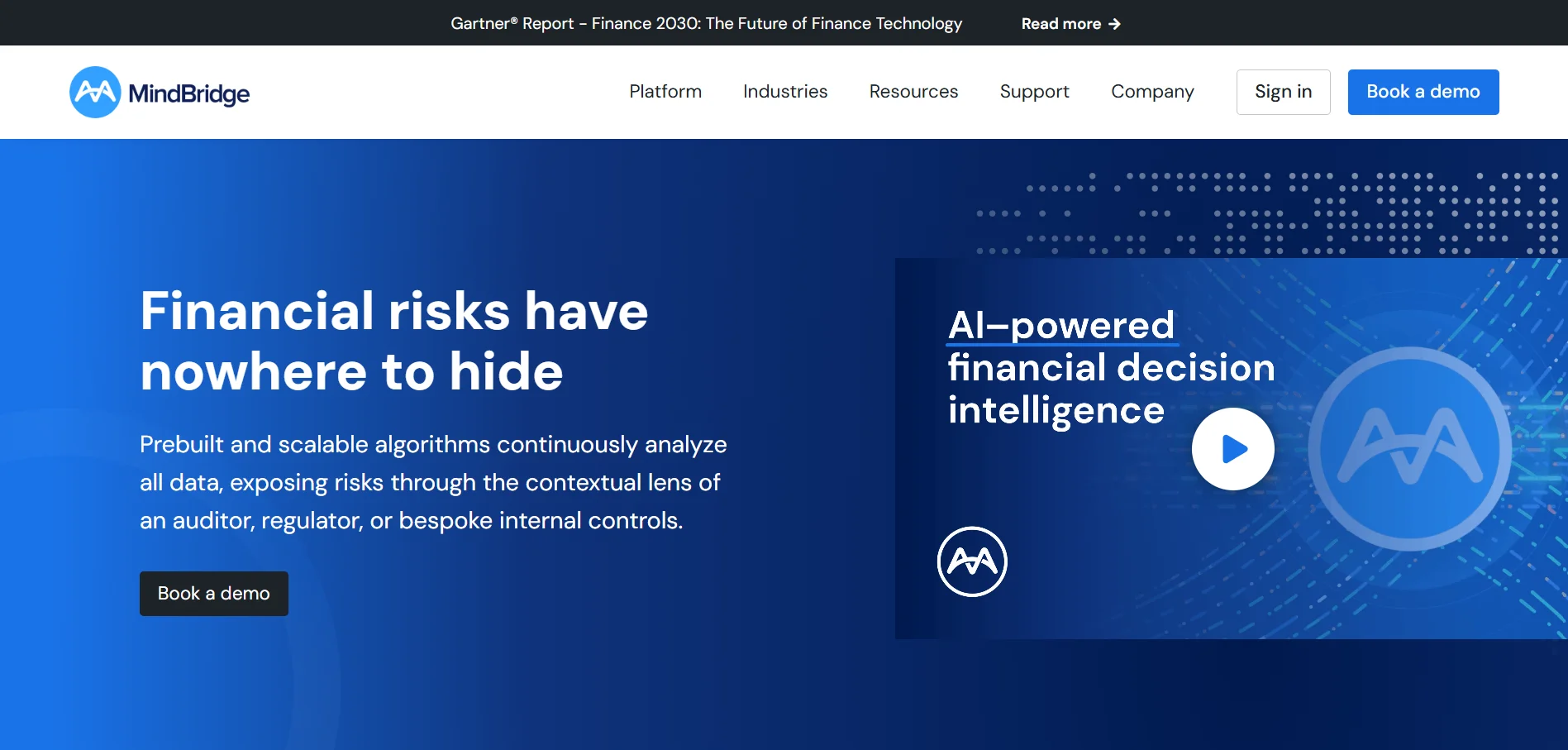
MindBridge focuses on analyzing complete financial datasets instead of relying on sampling. It uses machine learning to surface unusual patterns and risk signals across transactions. This makes it a strong fit for audit firms and enterprises that need deeper visibility into large volumes of financial data.
Unique Features:
- Ensemble AI risk scoring across 100% of transactions using multiple control points and statistical models
- Explainable AI with audit-ready reasoning and traceable outputs
- Granular anomaly detection with transaction-level drilldowns and risk prioritization
- Continuous monitoring with real-time financial risk insights
Pros:
- Full dataset analysis with strong risk detection
Analyzes 100% of transactions and surfaces high-risk anomalies, improving audit coverage and accuracy. - Clear, explainable insights for better decision-making
Simplifies complex financial data with intuitive dashboards and transparent reasoning behind flagged risks.
Cons:
- Challenges with ERP integration and initial data setup
Integrating with complex ERP systems and preparing unstructured data can be time-consuming, especially in the early stages. - Learning curve and limited clarity in some risk explanations
Teams unfamiliar with AI tools may require onboarding, and in some cases, the reasoning behind risk scores could be more transparent.
Trullion
What it is:
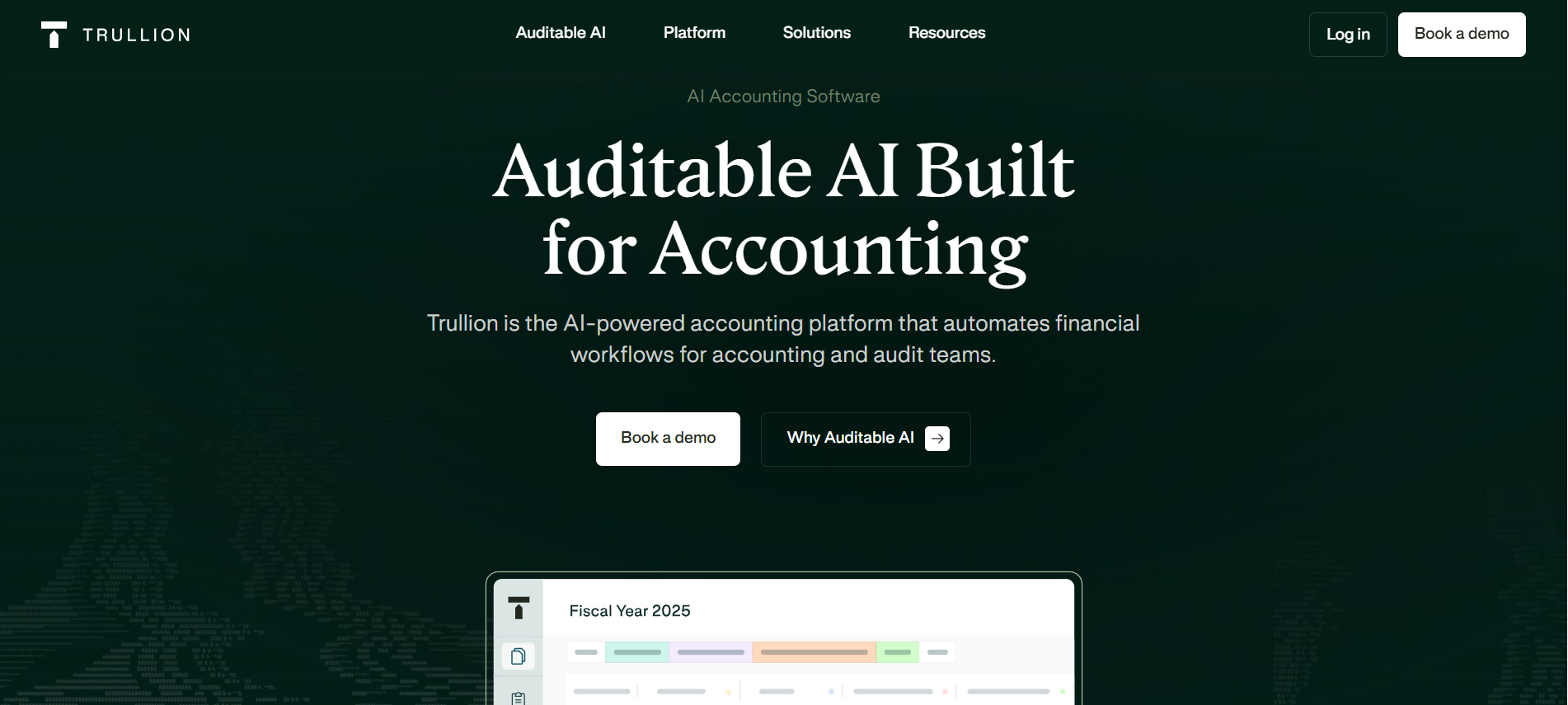
Trullion is built for automating complex accounting workflows like revenue recognition and lease accounting. It extracts structured data from contracts using AI, reducing manual effort and improving accuracy. The platform helps finance teams maintain audit readiness continuously rather than fixing issues at period end.
Unique Features:
- Auditable AI with source-linked outputs (every insight tied back to documents)
- Agentic AI assistant (“Trulli”) for querying financial data and accounting standards
- Automated data extraction from contracts, leases, and financial documents
- Unified knowledge layer combining policies, standards, and financial data
Pros:
- Automates complex accounting workflows with high accuracy
Streamlines processes like lease accounting and data reconciliation, reducing manual effort and minimizing errors. - Strong data matching and real-time discrepancy detection
Pulls data from multiple sources, aligns it accurately, and flags inconsistencies instantly, improving audit efficiency and reliability.
Cons:
- Limitations in data extraction and AI query accuracy
Some users report challenges in extracting data from certain documents and note that AI-driven queries may not always return accurate or complete results. - Navigation and usability challenges in the interface
The UI can feel unintuitive, requiring users to rely on manuals, with limited flexibility for working directly within familiar tools like Excel.
DataSnipper
What it is:
DataSnipper enhances audit workflows directly within Excel, where most auditors already operate. It automates repetitive tasks like document matching and data extraction without requiring teams to switch tools. This makes it ideal for improving efficiency within existing audit processes.
Unique Features:
- Native Excel integration with no need to switch tools
- Automated document matching and audit evidence linking
- AI-powered data extraction directly into audit workflows
- Built-in audit trail creation for documentation and compliance
Pros:
- Improves audit efficiency and documentation
Simplifies tasks like vouching documents, gathering client data, and supporting audit conclusions within working papers. - Enhances data extraction directly within Excel workflows
Makes it easy to extract, organize, and review information without switching tools, saving time in audit processes.
Cons:
- Occasional usability issues in table extraction
Defining rows and columns during table snipping can be inconsistent or slightly difficult. - Performance glitches within Excel environment
Users report issues like upload delays and cell input errors affecting workflow reliability.
Optro
What it is:
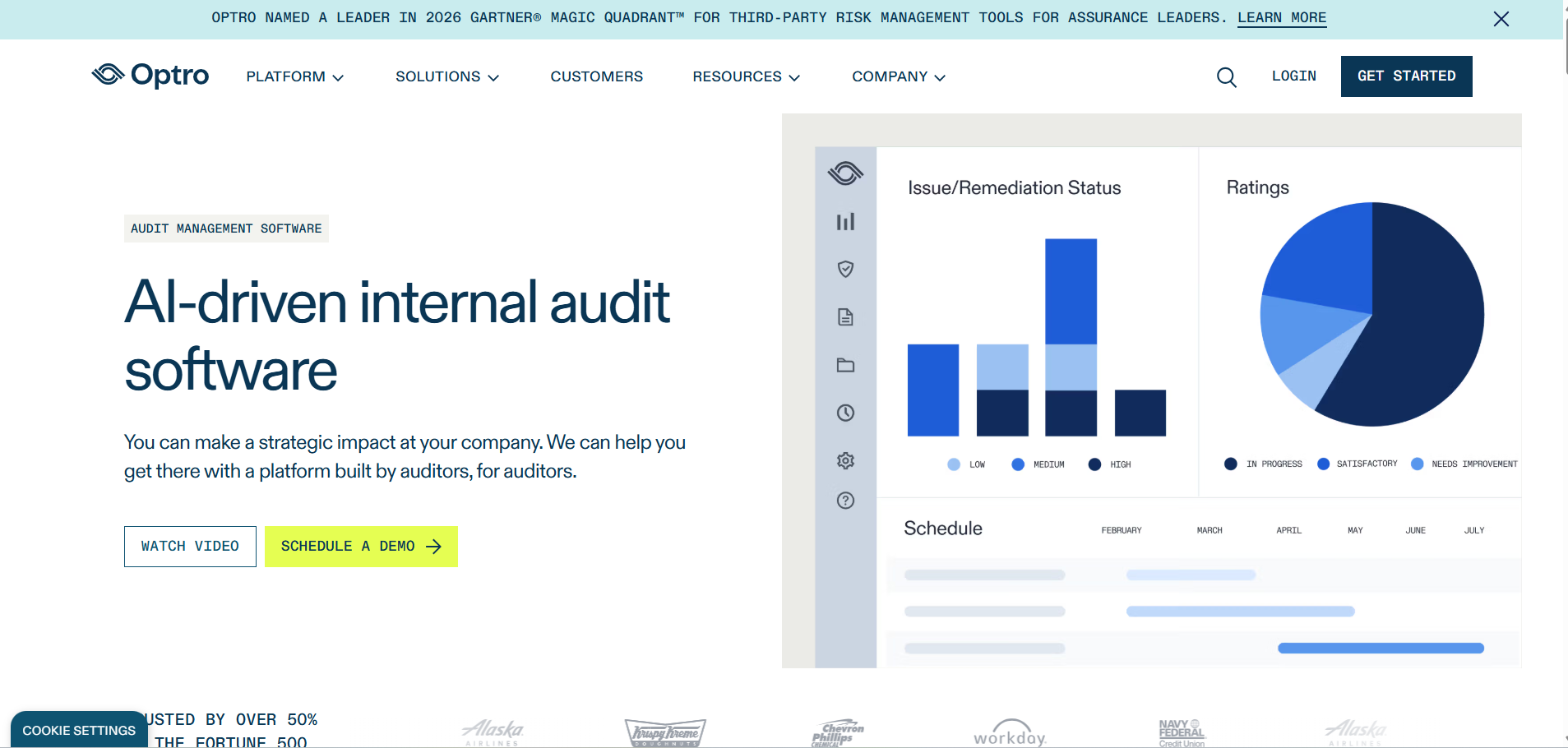
Optro takes an AI-native approach to internal audit and risk management. It uses agentic AI to continuously monitor controls and detect risks as they emerge. The platform is designed for organizations moving toward real-time, continuous auditing.
Unique Features:
- Agentic AI for continuous audit and control monitoring
- Automated control testing and risk detection workflows
- Real-time audit execution instead of periodic reviews
- Integrated audit, risk, and compliance management in one platform
Pros:
- User-friendly interface with strong audit efficiency
Easy to use and intuitive, helping teams streamline audit workflows, stay organized, and improve overall efficiency. - Seamless integration of workpapers and audit processes
Combines audit tests and documentation in one place, improving accuracy and making audit management more structured.
Cons:
- Limited functionality and customization flexibility
Users report constraints in features and customization, making it difficult to adapt the platform to specific internal audit processes. - Usability challenges and gaps in support resources
Inadequate user guides and documentation can make navigation and adoption harder, especially for new users.
Caseware
What it is:
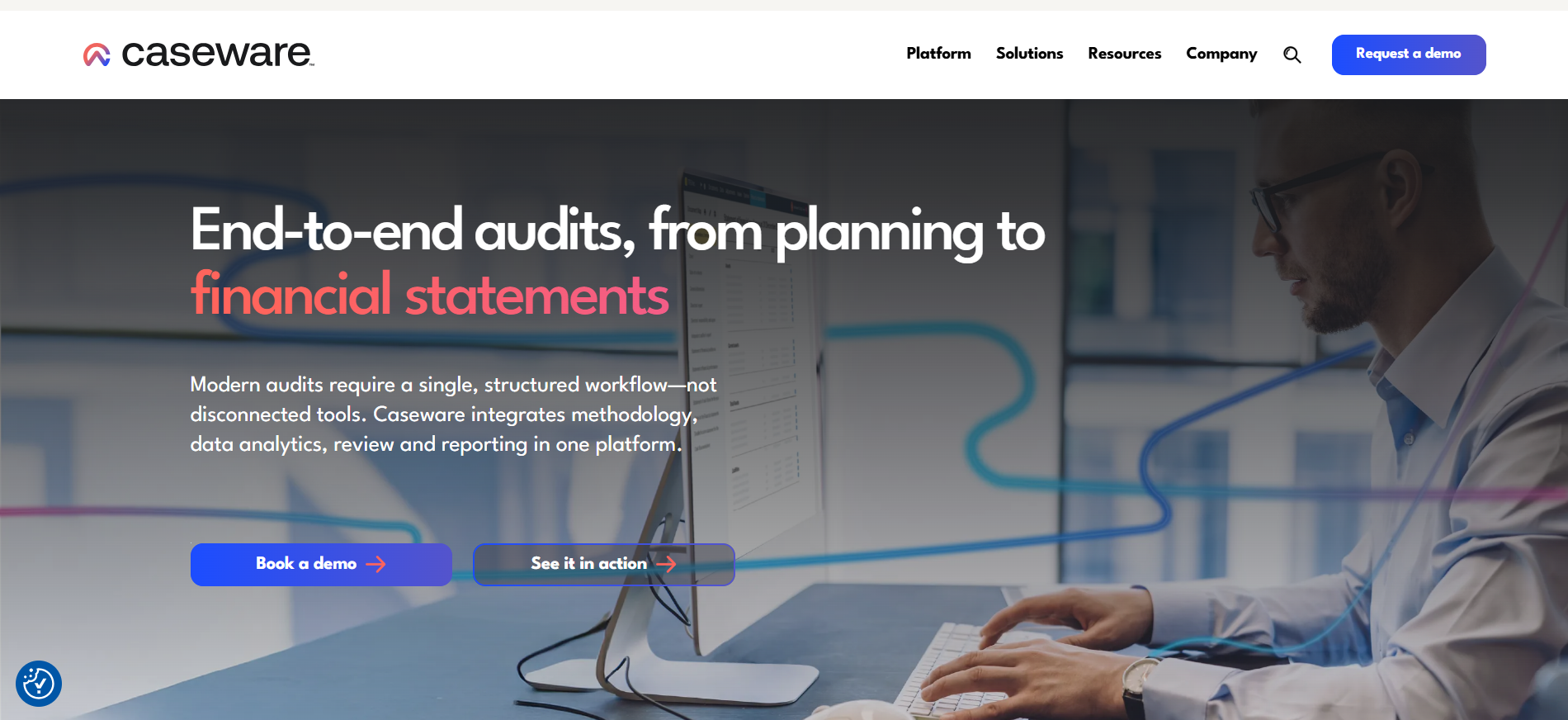
Caseware’s AI platform is embedded directly into audit workflows, helping teams reduce manual effort, improve accuracy, and identify risks earlier. Instead of operating as a separate tool, it works within the audit process to deliver insights while keeping human judgment central. It enhances audit efficiency and consistency through a combination of automation, analytics, and AI-driven guidance across the entire engagement lifecycle.
Unique Features:
- AI embedded directly into audit workflows for real-time guidance and automation
- AiDA assistant helps with audit queries, document summarization, and methodology support
- Early detection of anomalies and risks across financial data and documents
- Built for audit environments with strong compliance, security, and data governance controls
Pros:
- Comprehensive audit platform with strong automation
Handles large volumes of financial data efficiently, with automated working papers, structured templates, and robust audit trails. - Improves audit quality with structured workflows and integrations
Features like dynamic trial balance linking and built-in risk assessment tools enhance accuracy, consistency, and team collaboration.
Cons:
- Steep learning curve and time-intensive setup
Initial configuration, mapping, and template setup can be complex, especially for new users. - Outdated interface and occasional performance issues
The UI can feel clunky, and performance may slow down with large files or during cloud synchronization.
Inflo
What it is:
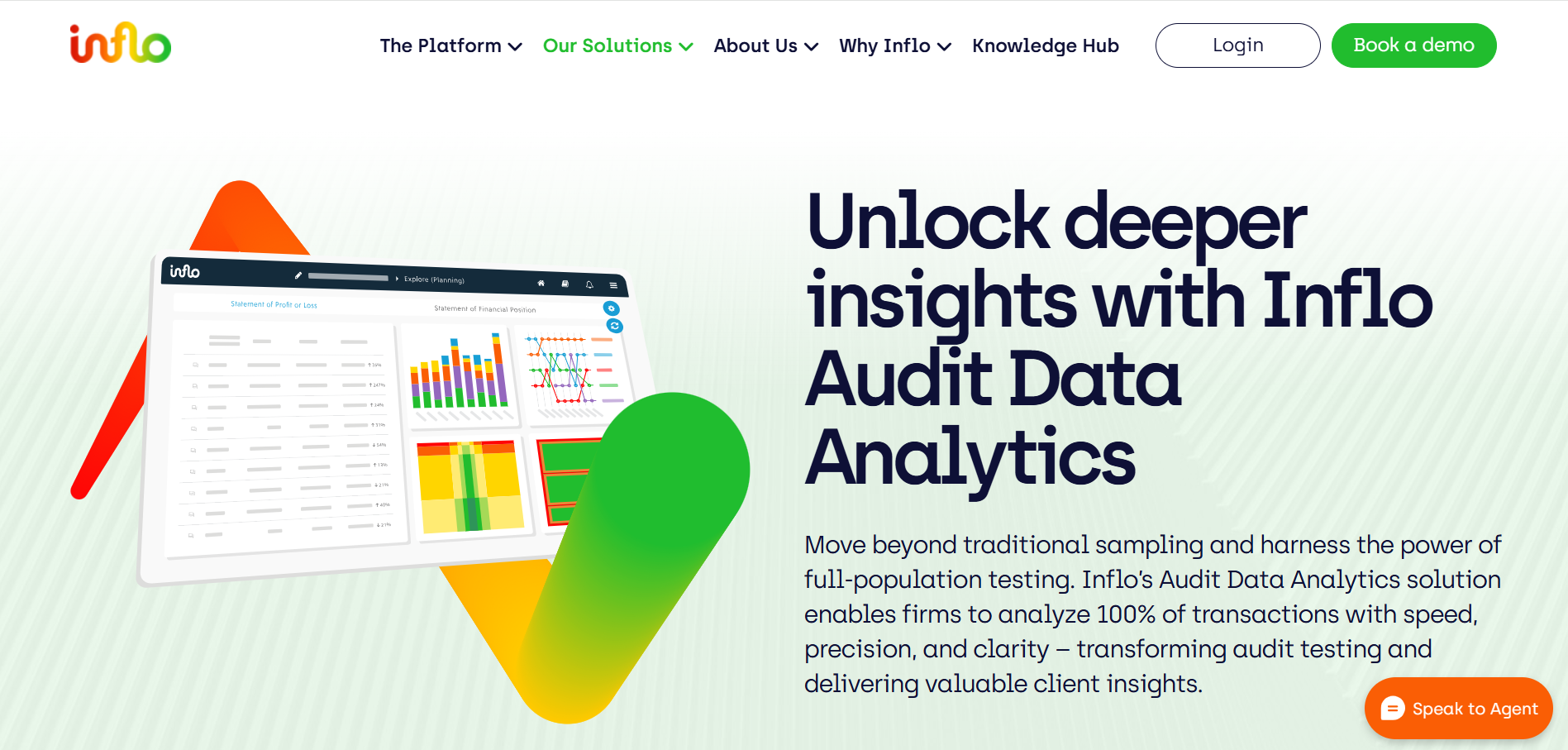
Inflo is designed for audit firms adopting more data-driven audit methods. It combines AI-based risk analysis with structured workflows to move beyond manual sampling. The platform helps teams modernize audits without overhauling their entire process.
Unique Features:
- Data-driven audit methodology with full dataset analysis
- AI-assisted anomaly detection integrated into audit workflows
- Guided audit processes aligned with audit standards
- Cloud-based collaboration for audit teams and clients
Pros:
- User-friendly platform with strong audit quality focus
Designed to support compliance and improve audit effectiveness, with an intuitive interface that becomes easy to navigate. - Reliable solution with responsive customer support
Easy to integrate and backed by a supportive team, making implementation and day-to-day usage smooth.
Cons:
- Limited training resources and documentation clarity
Users report a need for more comprehensive learning materials and clearer documentation. - Proactive communication and guidance could improve
Some users feel more regular updates, guidance, or onboarding support would enhance the overall experience.
How do manual and AI systems scale differently?
TL;DR
Manual audits become slower and less effective as data grows. AI-powered audits scale with complexity, improving accuracy, speed, and risk detection.
How do roles evolve?
TL;DR
Teams shift from manual, operational tasks to strategic, decision-focused roles, using AI to drive insights and faster decision-making.
Why is AI adoption accelerating in auditing?
According to research from SAS Institute and ACFE:
- 83% of anti-fraud professionals expect to adopt AI tools within two years
- Many organizations are increasing investments in audit technology
However, adoption is uneven.
This creates a growing gap:
- Early adopters gain real-time visibility and faster detection
- Late adopters rely on outdated, manual processes
AI in auditing is no longer experimental. It is becoming standard infrastructure.
Conclusion: What defines the future of financial auditing?
The future of auditing is shaped by three fundamental shifts:
- From sampling to full dataset coverage
- From periodic audits to continuous monitoring
- From reactive validation to proactive risk intelligence
AI-powered financial audit software makes all three possible. It expands audit visibility, reduces the time to detect risks, and transforms auditing from a periodic task into a continuous, insight-driven function.
This is no longer just about efficiency. It’s about building a system that keeps up with the scale and complexity of modern financial operations.
The question is no longer whether AI will become standard in auditing. It’s how long organizations can afford to operate without it.
FAQs
1. What is AI-powered financial audit software?
AI-powered financial audit software uses machine learning to analyze financial data, detect anomalies, and monitor risks in real time. Unlike traditional tools, it evaluates entire datasets instead of relying on sampling.
2. How is AI auditing different from traditional auditing?
Traditional auditing relies on sampling and manual checks, while AI auditing analyzes 100% of transactions, detects patterns, and flags risks continuously, improving both accuracy and speed.
3. Is AI-powered audit software secure and compliant in the US?
Yes, most leading platforms are built to meet US compliance standards such as SOX (Sarbanes-Oxley), with strong data security, audit trails, and governance controls.
4. Who should use AI-powered financial audit tools?
Audit firms, finance teams, and enterprises handling large volumes of financial data benefit the most, especially those looking to improve audit efficiency and risk visibility.
5. Can AI replace human auditors?
No, AI does not replace auditors. It supports them by automating repetitive tasks and identifying risks, allowing professionals to focus on judgment, analysis, and decision-making.
6. What features should you look for in AI audit software?
Key features include full dataset analysis, explainable risk insights, ERP integrations, real-time monitoring, and scalability with growing data complexity.
.webp)
.webp)

